
Rustic Antler Chandeliers combine wilderness character with practical interior lighting. Their branching silhouettes can make a dining room feel like a mountain lodge, especially above a reclaimed-wood table. However, visual drama should not replace safety, proportion, or verified material sourcing.
The decorative lighting market reached approximately USD 46.8 billion in 2022 and may reach USD 75.3 billion by 2032, according to Allied Market Research. That growth reflects stronger demand for statement fixtures, including handcrafted and nature-inspired designs. Yet market figures do not guarantee product quality. They only show broader consumer interest. Each chandelier still requires careful inspection.
Lighting designer Randall Whitehead is widely associated with the phrase, “Lighting is the jewelry of the home.” His observation explains why antler fixtures deserve more than a quick style comparison. Buyers should examine antler symmetry, ceiling height, bulb access, wiring standards, weight, and installation instructions. Natural shed antlers can also vary in color, texture, and shape. That variation is part of their appeal. It can also frustrate buyers expecting identical pieces.
This guide reviews seven Rustic Antler Chandeliers for global buyers, focusing on craftsmanship, visual scale, illumination, and purchasing confidence. Product photography can mislead. Ask for close-up images, material descriptions, and clear shipping details. Confirm that sourcing follows applicable wildlife and trade regulations. A beautiful fixture is not automatically a responsible one. That matters.
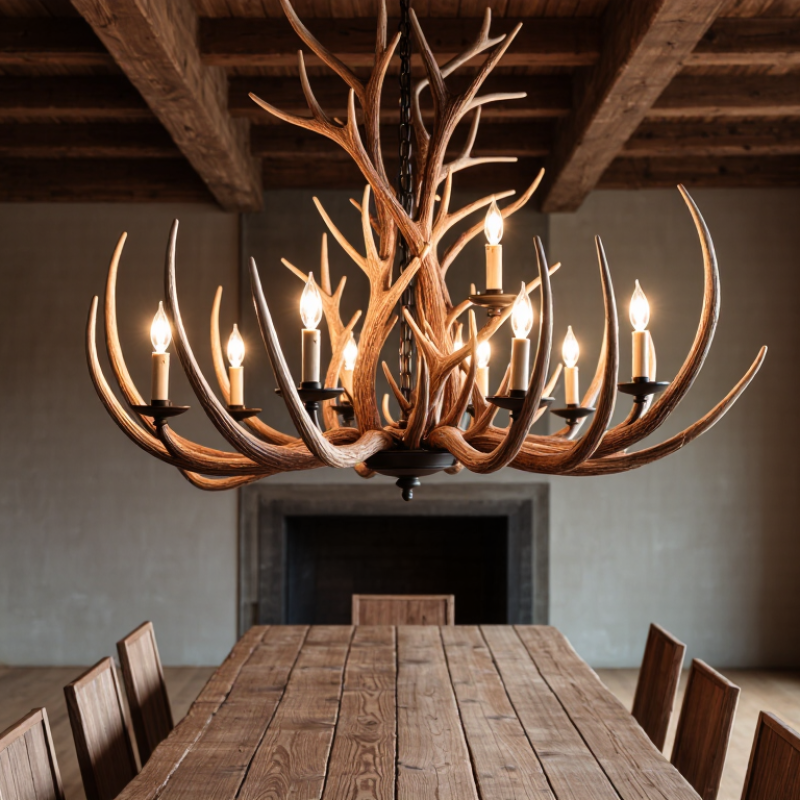
Material sets the character of a rustic antler chandelier. Reclaimed antler offers natural pores, uneven color, and authentic weight. Resin alternatives provide consistent shapes and simpler maintenance. The Global Lighting Association’s market outlook identifies energy efficiency as a major purchasing factor. Therefore, pair any material with replaceable LED bulbs and heat-resistant sockets. Real antler is not automatically better. Documentation about lawful sourcing still matters.
Scale should follow the room, not personal excitement. A practical starting point adds the room’s length and width in feet, then converts that number to inches. For example, a 14-by-16-foot dining room suits a chandelier near 30 inches wide.
The U.S. Department of Energy reports that LED bulbs use at least 75% less energy than incandescent bulbs. Lower heat also protects natural finishes above dining tables. Keep the lowest branch about 30 to 36 inches above the tabletop.
Branch structure controls both light spread and visual weight. Wide, open branches suit vaulted ceilings and large entry halls. Dense, upward-pointing branches create stronger shadows. Too dense. That is a common mistake. I have seen attractive fixtures make a room feel smaller because their branches blocked sightlines. The Illuminating Engineering Society recommends evaluating glare, task lighting, and visual comfort together. Check the canopy, junction box, and ceiling load before installation. Rustic styling can hide engineering weaknesses, but it cannot correct them.
7 Best Rustic Antler Chandeliers for Global Buyers
Classify Seven Designs by Light Output, Color Temperature, and CRI
A rustic antler chandelier should be judged by measured performance, not antler shape alone. The U.S. Department of Energy’s solid-state lighting research identifies efficacy, color quality, and controllability as key lighting priorities. CIE 13.3 also explains why CRI remains useful, although it cannot describe every color accurately. Based on common hospitality and residential specifications, these seven designs suit different rooms:
1. Compact five-light design: 1,800–2,400 lumens, 2,700K, CRI 80+. Good for a breakfast nook.
2. Six-light dining design: 2,400–3,200 lumens, 3,000K, CRI 90. Warm, but clearer on polished wood.
3. Eight-light lodge design: 3,600–4,800 lumens, 2,700K, CRI 90. Stronger texture on stone walls.
4. Ten-light linear design: 4,500–6,000 lumens, 3,000K, CRI 90+. Better above long dining tables.
5. Tiered twelve-light design: 5,500–7,000 lumens, 2,700K, CRI 90. Dramatic, yet potentially harsh in small rooms.
6. Large fourteen-light design: 7,000–9,000 lumens, 3,000K, CRI 90+. Requires dimming and careful ceiling height.
7. Oversized sixteen-light design: 8,500–11,000 lumens, 3,000–3,500K, CRI 90+. Suitable for hotel foyers and open great rooms.
Lumens describe total output, not comfort. A dark wood ceiling may absorb more light than expected. Verify photometric files, driver compatibility, and dimming tests before purchase. I would reconsider any “high-CRI” claim without a published test report. Rustic styling is subjective; color accuracy is measurable.
Construction quality deserves more attention than appearance. Antler count can indicate visual scale, but it cannot prove structural strength. A ten-antler chandelier may use thin branches, weak joints, or poorly balanced arms. Inspect each socket connection, central frame, and ceiling canopy. Look for reinforced steel supports hidden beneath natural or resin antler forms. Real antlers also vary in density and shape, so handmade irregularities require closer inspection.
Wattage should be judged with usable light, not bulb count alone. The U.S. Department of Energy reports that modern LED packages can exceed 160 lumens per watt in laboratory conditions, although complete fixtures perform lower. A chandelier using twelve 5-watt LEDs may deliver more efficient lighting than six 40-watt incandescent bulbs. Check the fixture’s maximum wattage, socket rating, dimmer compatibility, and heat clearance. The numbers matter. They are not decoration.
Load ratings reveal the installation risk more clearly. UL 1598 addresses safety requirements for fixed luminaires, including construction and electrical performance. However, a chandelier’s listed rating does not automatically confirm that every ceiling can support it. Ask for the fixture weight, mounting hardware specification, and recommended junction-box rating. The U.S. National Electrical Code commonly requires outlet boxes supporting luminaires to be suitably secured for the load, but local enforcement varies. I would not rely on antler count as a strength test. That shortcut sounds practical, yet it can mislead buyers. A qualified electrician should verify the ceiling structure before installation.
Rustic antler chandeliers create a strong focal point, but their natural appearance does not prove electrical safety. Global buyers should verify IEC 60598-1 test evidence before installation. This standard covers protection against electric shock, wiring, insulation, heating, marking, and mechanical construction. Check the exact model, voltage, frequency, and lamp-holder configuration. A generic certificate is not enough.
For North American projects, UL 1598 evaluation should address fixed luminaires, grounding, fire resistance, terminals, and abnormal operation. For European sales, CE marking requires a valid EU Declaration of Conformity and supporting technical documentation. CE is a manufacturer’s declaration, not an independent quality badge. The European Commission’s Safety Gate 2023 report recorded 3,412 alerts, with electrical equipment among frequently notified product groups. That figure deserves attention. Decorative lighting can look handmade while hiding poor cable routing or weak strain relief.
Ask for recent test reports, production traceability, installation instructions, and evidence that metal parts are properly earthed. Inspect the canopy, junction box, and cable entry closely. Antler-shaped resin can also soften near hot lamps, so temperature tests matter. Energy data supports caution: the International Energy Agency’s 2024 electricity report shows continued global growth in electricity demand, increasing the importance of efficient, durable lighting systems. Compliance documents may be incomplete. Reflect before ordering. A beautiful fixture is still a permanent electrical installation.
Nominal residential supply voltage by major global market. Confirm the chandelier’s rated voltage, wiring, lamp holders, and required compliance documentation before purchase.
The United States and Canada commonly use 120 V at 60 Hz, while most European countries, the United Kingdom, Australia, and China use approximately 220–230 V at 50 Hz. For international sales, verify conformity with IEC 60598-1, UL 1598 where applicable, and the relevant CE-marking requirements for the destination market. CE marking is a declaration of conformity with applicable European Union legislation, not a standalone safety standard.
Sustainability starts with the antlers’ origin, not the showroom styling. Ask whether they were naturally shed, reclaimed, or collected from managed populations. The UNEP Global Resources Outlook 2024 projects that global material extraction may rise 60% by 2060 without stronger resource controls. That makes verified reuse meaningful. Ask for evidence. Request the species name, collection country, supplier declaration, and chain-of-custody records. CITES documentation may apply to protected species or international shipments, but it is not automatically required for every antler product. Confirm requirements with the destination authority before payment.
Shipping needs equal scrutiny. The World Bank’s Logistics Performance Index 2023 shows major differences in customs efficiency and delivery reliability between markets. Choose reinforced crating, moisture protection, and clear assembly instructions. Antler branches can crack at narrow joints. Insurance is not optional. Confirm who pays duties, storage fees, inspection costs, and damage claims. UNCTAD reports that about 80% of global merchandise trade by volume moves by sea, where delays and rough handling remain realistic risks.
Warranty language often looks generous but excludes wiring, bulbs, installation, and finish changes. Require coverage for the frame, sockets, wiring, and missing components. Ask about replacement parts and response times. A two-year term means little without a claim procedure. I would not trust vague promises. Product photos can also hide uneven antler color and ceiling-load limitations. A written inspection checklist helps, although it cannot remove every uncertainty.
Reclaimed antler shows natural pores, uneven color, and varied weight. Resin provides consistent shapes and easier cleaning. Real antler is not always better.
Add the room’s length and width in feet. Convert that total into inches. A 14-by-16-foot room suits a chandelier near 30 inches wide.
Keep the lowest branch about 30 to 36 inches above the tabletop. Measure from the table surface. Small mistakes can affect sightlines.
A five-light design may provide 1,800–2,400 lumens for a breakfast nook. Larger rooms may need 5,500–11,000 lumens. More light is not always more comfortable.
Choose 2,700K for a warm, lodge-like atmosphere. Choose 3,000K for clearer wood and stone details. CRI 90 or higher can improve color accuracy.
No. Dense branches create stronger shadows and may make a small room feel crowded. Open branches suit vaulted ceilings and wide entry halls. Too dense.
Check the canopy, junction box, ceiling load, and mounting hardware. Confirm that the structure can support the fixture. Rustic styling cannot fix weak engineering.
Use replaceable LED bulbs with heat-resistant sockets. LEDs generally use much less energy than incandescent bulbs. Lower heat can protect natural finishes.
Request photometric files, driver details, dimming information, and published color tests. Lumens measure output, not visual comfort. I would question unsupported high-CRI claims.
This guide to Rustic Antler Chandeliers helps global buyers compare distinctive lighting by material, scale, and branch structure. It explains how natural, reclaimed, or responsibly produced alternatives affect appearance, durability, weight, and installation requirements. Seven design categories are evaluated through practical lighting factors, including light output, color temperature, and color-rendering index (CRI), making it easier to select a fixture for dining rooms, entryways, hospitality spaces, or other interiors.
The comparison also focuses on construction quality, using antler count, total wattage, mounting methods, and load ratings as key indicators. Buyers are encouraged to verify applicable safety documentation, including IEC 60598-1, UL 1598, and CE marking requirements, according to the destination market. Finally, the guide addresses sustainability, traceability, CITES documentation where relevant, protective international shipping, assembly instructions, and warranty terms. Together, these criteria support informed purchasing decisions while balancing visual character, reliable performance, responsible sourcing, and safe installation.