
China’s hospitality market is becoming more design-led, energy-conscious, and technically demanding. Hotels, resorts, restaurants, and serviced apartments now expect lighting suppliers to deliver more than attractive fixtures. They need dependable controls, efficient LEDs, flexible color temperatures, and strong after-sales support. This is where Hospitality Commercial Lighting becomes a practical business decision, not merely a decorative choice.
The International Energy Agency reports that lighting represents about 15% of global electricity consumption. The U.S. Department of Energy also states that LED products can use at least 75% less energy and last up to 25 times longer than incandescent lamps. These figures matter in a hotel corridor operating all night, a restaurant with warm table lighting, or a lobby requiring dramatic visual accents. Dr. Russell Foster, a leading circadian-rhythm researcher at the University of Oxford, has said, “Light is the most powerful synchronizer of the human body clock.” His observation reminds designers to consider guest comfort, sleep quality, and human experience, not only brightness.
This guide examines China’s top ten Hospitality Commercial Lighting suppliers through product range, certifications, customization ability, project experience, quality control, and service responsiveness. Supplier rankings are never perfect. A factory may offer excellent optical performance but limited international support. Another may provide strong design assistance while lacking transparent project references. Those differences deserve careful review. Buyers should compare photometric files, warranty terms, control compatibility, and real installation results before choosing a partner. A polished catalog is useful. Evidence is better.
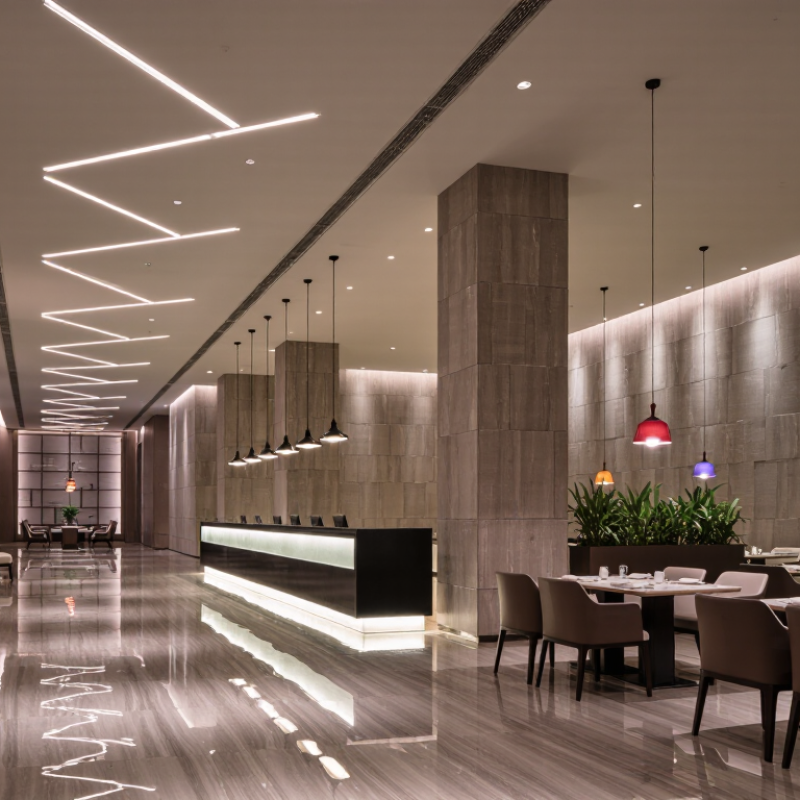
Evaluating China’s hospitality commercial lighting suppliers requires more than comparing prices. The IEA’s Energy Efficiency 2023 report estimates that lighting consumes about 15% of global electricity. The U.S. Department of Energy also reports that LED products use at least 75% less energy than incandescent lamps. These figures make efficiency important, but hotel performance depends on comfort, durability, and control.
Request LM-79 photometric reports, IES files, and test records for each proposed fixture. Check CRI, R9, color consistency, flicker, glare, and beam accuracy. A restaurant may need warm 2700K light, while corridors require dependable uniformity. Ask suppliers to demonstrate a working sample, not only a polished catalog. Measure the light.
Factory capability matters. Review thermal testing, driver quality, aging procedures, and production traceability. Confirm compliance with applicable IEC and Chinese lighting requirements. Site experience is useful, but references should include measurable results, such as maintenance frequency and replacement rates. The DOE’s LED Lighting Factsheet states that LEDs can last up to 25 times longer than incandescent lamps, yet real hotel conditions can shorten service life through heat and continuous operation.
Warranty terms need careful reading. Does coverage include drivers, discoloration, and control-system faults? Lead times should be tested with a small pilot order. Some suppliers provide excellent samples but inconsistent production batches. That weakness is easy to miss. Pricing remains relevant, although the cheapest quotation may create higher replacement and labor costs later.
| Rank | Evaluation Profile | Weighted Score | Quality & Compliance | Hospitality Product Coverage | Customization Capability | Typical Lead Time | Warranty Practice | Project Support | Export Readiness | Best-Fit Project Type |
|---|---|---|---|---|---|---|---|---|---|---|
| 1 | Profile A | 92 / 100 | Documented quality system; CE and RoHS documentation commonly available |
Architectural downlights, linear systems, decorative fixtures, outdoor luminaires | High; optical distribution, finish, mounting, dimming and color-temperature options | 4–8 weeks for standard projects | Commonly 3–5 years, subject to product category | Lighting layouts, mock-ups, sample review and technical submittals | Strong; export packaging and multilingual documentation | Luxury hotels and large mixed-use developments |
| 2 | Profile B | 90 / 100 | Traceable inspection records and stable LED component sourcing |
Guest-room lighting, corridor lighting, bathroom fixtures and public-area systems | High; can adapt dimensions, finishes, control interfaces and installation details | 5–9 weeks for customized orders | Typically 3–5 years | Good coordination with interior designers, contractors and MEP teams | Strong; standardized packing and commercial export documentation | International hotel chains and resort renovations |
| 3 | Profile C | 88 / 100 | Routine electrical, photometric and aging tests available |
Downlights, spotlights, wall washers, cove lighting and cabinet lighting | High; suitable for repeated room types and coordinated decorative schemes | 4–7 weeks for standard ranges | Commonly 3 years | Photometric files, installation instructions and sample support | Good; experienced with container loading and export labeling | Business hotels, serviced apartments and retail-hospitality spaces |
| 4 | Profile D | 86 / 100 | Consistent production inspection and compliance-file preparation |
Linear profiles, pendant fixtures, track systems and decorative project lighting | Very high; strong metalwork, glass, fabric and finish coordination | 6–10 weeks for decorative products | Typically 3 years | Prototype development, finish boards and installation coordination | Good; suitable for project-based international purchasing | Boutique hotels, restaurants and branded interior concepts |
| 5 | Profile E | 84 / 100 | Basic reliability testing with documented incoming-material controls |
Commercial downlights, panels, bulkheads and general-purpose hospitality lighting | Medium to high; standard products can be modified in batches | 3–6 weeks for standard items | Commonly 2–3 years | Good product selection support and quantity-based quotation | Good; suitable for regular export orders | Economy hotels, student accommodation and refurbishment programs |
| 6 | Profile F | 82 / 100 | Product testing available; project documentation should be confirmed per order |
Outdoor wall lights, landscape lighting, bollards and entrance lighting | Medium; focuses on housing, finish and mounting adaptations | 5–8 weeks | Typically 2–3 years | Outdoor lighting calculations and installation guidance | Good; weather-resistant packaging is generally available | Resorts, entrance areas, gardens and poolside environments |
| 7 | Profile G | 80 / 100 | Standard electrical safety and performance checks |
Guest-room reading lights, bedside fixtures, mirrors and vanity lighting | Medium to high; useful for room-package standardization | 5–9 weeks | Commonly 2–3 years | Room mock-up support and coordinated finish samples | Moderate to good; documentation quality varies by project | Guest-room packages and mid-scale hotel developments |
| 8 | Profile H | 78 / 100 | Quality control is generally suitable for standard commercial applications |
High-bay fixtures, service-area lighting, kitchen lighting and back-of-house products | Medium; prioritizes standardized, cost-controlled configurations | 3–6 weeks | Typically 2 years | Basic technical selection and replacement-part support | Moderate; export requirements should be checked before ordering | Back-of-house areas, kitchens, storage and service corridors |
| 9 | Profile I | 76 / 100 | Suitable for standard products when required specifications are clearly defined |
Decorative pendants, chandeliers, wall sconces and feature lighting | High for appearance; production capacity should be verified for large quantities | 7–12 weeks for bespoke decorative fixtures | Commonly 2 years | Finish samples, drawing confirmation and pre-production approval | Moderate to good; careful packing inspection is recommended | Restaurants, lounges, lobbies and statement interiors |
| 10 | Profile J | 74 / 100 | Compliance and test reports should be reviewed for each product series |
Standard LED bulbs, surface fixtures, emergency lighting and replacement products | Low to medium; strongest in catalog-based products | 2–5 weeks for stocked or standard items | Typically 1–2 years | Basic quotation, product matching and replacement support | Moderate; suitable for smaller and repeat procurement orders | Small hotels, renovations and maintenance replacement programs |
Evaluation basis: product quality and compliance documentation (25%), hospitality product coverage (20%), customization capability (15%), delivery performance (15%), warranty and after-sales support (10%), project support (10%), and export readiness (5%). The profiles are anonymized benchmark categories for supplier comparison; actual performance should be verified through samples, factory audits, current certificates, project references and a written warranty.
Compare more than prices. Review efficiency, comfort, durability, controls, warranty coverage, and maintenance access. A polished catalog proves little.
Request LM-79 photometric reports, IES files, test records, installation drawings, and control compatibility details. Measure a working sample, too.
Check CRI, R9, color consistency, flicker, glare, beam accuracy, and illuminance. Guestrooms need comfort, not excessive brightness.
Restaurants often suit warm 2700K light and high color rendering. Corridors need uniform illumination, low glare, and dependable sensors.
Inspect thermal testing, driver quality, aging procedures, and production traceability. Reliable samples may still hide inconsistent production batches.
Test lead times, dimming behavior, color consistency, installation effort, and actual light levels. Small trials expose problems early.
Confirm coverage for drivers, discoloration, control faults, and replacement parts. Ask how claims are handled after continuous operation.
Low prices may bring frequent replacements, labor costs, glare complaints, or difficult repairs. Initial savings can be misleading.
Occupancy sensors, daylight controls, DALI, and 0–10V systems can reduce waste. Commissioning matters. Poor aiming still wastes light.
Ask for completed projects and measurable results, including replacement rates and maintenance frequency. References should describe real site performance.
This article provides a practical overview of China’s Hospitality Commercial Lighting supply market and explains how suppliers can be evaluated for hotels, restaurants, resorts, and other guest-focused spaces. It introduces the key criteria for identifying reliable manufacturers, including product quality, design capability, production capacity, certifications, energy efficiency, project experience, delivery performance, and after-sales support. It also presents a structured comparison of ten leading types of suppliers without focusing on brand names, helping readers understand their different strengths and application areas.
The article further reviews core product categories and lighting solutions, such as decorative fixtures, architectural lighting, ambient lighting, outdoor systems, smart controls, and customized project solutions. It discusses how suppliers manage quality assurance, compliance, bespoke design, technical coordination, and large-scale installations. Finally, it offers practical guidance for selecting the right partner by considering project style, budget, performance requirements, customization needs, installation conditions, communication efficiency, and long-term service capabilities.