
+1 800-222-4009 Designed, Engineered & Built in Yorkville, New York
0%

Choosing among the Top Custom Wrought Iron Lighting Manufacturers Worldwide requires more than comparing polished photographs. A chandelier may look dramatic online, yet its real quality appears in the forged joints, weld consistency, surface finish, and wiring details. This guide examines manufacturers through practical evidence, including workshop experience, design capability, material traceability, customization processes, and after-sales support.

Lighting designer Ingo Maurer once said, “Light is not just something you see; it is something you feel.” That principle matters when evaluating Custom Wrought Iron Lighting. Skilled manufacturers shape iron to create atmosphere, not merely decoration. Their fixtures should cast controlled shadows across plaster walls, sit securely above a dining table, and maintain visual balance from every angle. Reliable producers also explain metal thickness, coating systems, socket specifications, installation requirements, and applicable safety standards.

Details matter.

This overview considers both established names and specialized studios. Some excel at large hospitality projects, while others produce intimate residential pieces with hand-finished textures. Their strengths are not identical. A manufacturer with impressive craftsmanship may offer limited technical documentation. Another may provide excellent engineering but less expressive design. That distinction deserves attention.

No global ranking can remain perfectly final. Manufacturing methods change, workshops expand, and customer experiences may differ by region. Therefore, the comparison favors verifiable capabilities over promotional language. Samples, drawings, certifications, production photographs, and direct communication often reveal more than a beautiful catalog. Readers should still confirm current pricing, lead times, electrical compliance, and installation support before placing an order.
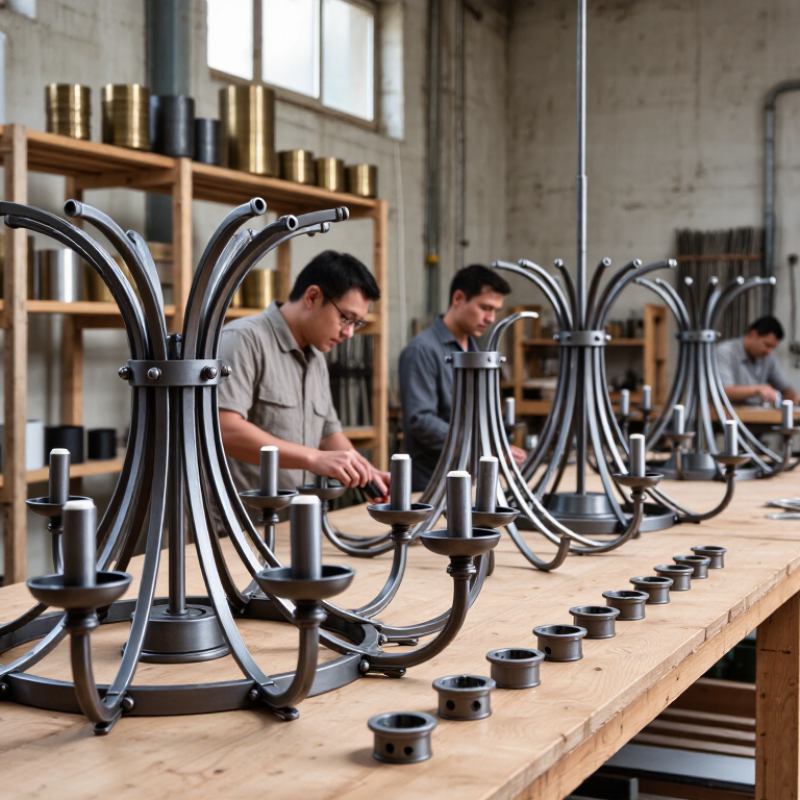
Top Custom Wrought Iron Lighting Manufacturers Worldwide

Definition and Scope of Custom Wrought Iron Lighting

Custom wrought iron lighting refers to fixtures designed around a client’s space, function, and visual preferences. Traditional wrought iron is tough, fibrous iron shaped through heating, bending, and forging. Today, many workshops use low-carbon steel because true wrought iron is rarely produced commercially. The difference matters. A reliable manufacturer should state the material clearly. A decorative metal frame is not automatically wrought iron. Custom work can include chandeliers, wall sconces, pendants, lanterns, and coordinated ceiling fixtures. Each piece may vary in arm shape, height, shade support, finish, and mounting method.

Its scope extends from early sketches to installation-ready components. Designers may request measured drawings, finish samples, adjustable chains, concealed wiring, or dimmable sockets. Hospitality projects often need repeated fixtures with consistent spacing and weight. Private residences may require one irregular centerpiece instead. Indoor and outdoor use demand different protection. Exterior fixtures need suitable coatings, sealed connections, and corrosion-aware hardware. Electrical components must match the destination’s voltage, socket requirements, and inspection rules. These details are not decoration. They affect safety, maintenance, and service life.

Experienced manufacturers usually confirm ceiling structure, heat clearance, cleaning access, and replacement-part availability before production. Handmade variation can enrich the surface, but it may also create uneven arms or unexpected shadows. Not always. That risk deserves discussion early. Some specifications remain imperfect until a full-size drawing exposes the problem. Good communication reduces costly changes, though it cannot remove every uncertainty. A clear scope should record dimensions, metal type, finish system, lamp compatibility, packaging, and installation responsibilities. Regional standards still require independent verification.

Key Design, Material, and Manufacturing Standards

Top Custom Wrought Iron Lighting Manufacturers Worldwide

Reliable wrought iron lighting begins with material honesty. Genuine wrought iron is now uncommon, so many workshops use low-carbon steel with a traditional forged appearance. Manufacturers should state the alloy, thickness, and surface treatment clearly. The World Steel Association reported global crude steel production of about 1.89 billion tonnes in 2023. That scale makes traceability essential, even for a small decorative fixture. Mill certificates, batch records, and corrosion testing provide stronger evidence than polished photographs.

Design must support safe installation, not only visual character. Fixtures should provide adequate clearance from combustible surfaces and protect wiring from sharp metal edges. IEC 60598-1 covers general safety requirements for luminaires, while IEC 60529 defines IP protection ratings. In North American projects, equivalent safety testing should match the intended installation environment. The International Energy Agency has reported that lighting uses roughly 15% of global electricity, making efficient LED compatibility a practical design standard. Still, a beautiful frame can hide poor heat management. That mistake deserves scrutiny.

Manufacturing quality appears in small details: even weld penetration, controlled distortion, clean threaded entries, and a continuous protective coating. ISO 9001-based process control can improve repeatability, but certification alone does not guarantee craftsmanship. A slight hand-forged mark may be acceptable; exposed rust under the finish is not. Ask for salt-spray results, coating specifications, dimensional drawings, and inspection photographs. Standards help, but honest documentation remains the real test.

How to Evaluate Global Wrought Iron Lighting Manufacturers

Top Custom Wrought Iron Lighting Manufacturers Worldwide

Evaluating global wrought iron lighting manufacturers requires more than comparing catalog photos. Begin with material evidence. Ask for steel grade, wire diameter, weld procedures, and coating thickness. A reliable supplier should provide batch records and inspection photographs. Request a physical sample. Small details matter, including clean weld beads, aligned arms, and smooth threaded joints.

Energy performance also deserves attention. The International Energy Agency reported that lighting represents about 15% of global electricity consumption. Therefore, confirm socket compatibility, LED thermal management, and replaceable driver options. The U.S. Department of Energy has also documented the rapid expansion of LED adoption, making heat control essential in enclosed iron shades. Ask for photometric files, electrical test reports, and installation instructions. Vague answers are warning signs.

Production capacity should be tested, not assumed. Review factory audit records, corrective-action reports, packaging trials, and sample-to-mass-production consistency. ASTM B117 salt-spray testing can help compare coating durability, although it does not perfectly reproduce every coastal environment. That limitation matters. A flawless showroom sample may hide inconsistent finishing on the tenth unit. Check lead times across several orders, not one promise. Also examine how the manufacturer handles rejected parts, design revisions, and damaged deliveries. The best evaluation combines laboratory documents with a close inspection of workmanship. It is slower, but usually cheaper than repairing fragile fixtures after installation.

Leading Manufacturer Profiles and Regional Strengths

Custom wrought iron lighting is a specialist field, not a simple extension of mass-market fixture production. Leading manufacturers differ by workshop capability, engineering discipline, and regional design literacy. European makers often excel at hand-forged scrolls, patinated finishes, and restoration-sensitive replicas. Their strongest evidence is physical: consistent weld penetration, balanced arms, and sample panels showing how finishes age. The market is smaller than general lighting, so buyer claims require careful verification.

In North America, established manufacturers commonly emphasize project documentation, load calculations, dimming compatibility, and certification pathways for hospitality and residential projects. Asia’s leading production centers often provide flexible tooling, competitive batch pricing, and faster sampling. Yet speed can conceal variation. Independent inspections should check tube thickness, socket alignment, coating adhesion, and packaging protection before shipment. The International Energy Agency reports that buildings use around 30% of global final energy, making efficient lamps and controls commercially important.

Middle Eastern and boutique European workshops frequently specialize in oversized chandeliers, layered metalwork, and highly tailored architectural installations. The U.S. Department of Energy states that LED products can use at least 75% less energy and last up to 25 times longer than incandescent lighting. A credible manufacturer profile should disclose material grades, finish testing, electrical documentation, and production capacity. One uncomfortable lesson remains: even experienced workshops can miss small details. Honest inspection records matter more than perfect catalog language.

Top Custom Wrought Iron Lighting Manufacturers Worldwide - Leading Manufacturer Profiles and Regional Strengths

Regional Profile Common Manufacturing Strength Typical Customization Capability Frequently Used Materials and Finishes Relevant Product Standards for Target Markets Typical Buyer Segments
Western Europe Heritage-inspired forging, architectural detailing, and small-batch decorative production Made-to-order dimensions, historical styling, bespoke brackets, and coordinated indoor/outdoor collections Steel or wrought-iron components, brass accents, hand-applied patinas, painted finishes, and powder coating EN 60598 series for luminaires; CE requirements apply to products placed on the European Union market Hospitality, heritage renovation, residential interiors, landscape projects, and luxury retail
North America Large-scale residential and commercial fixtures, project coordination, and code-oriented production Custom canopy sizes, multi-tier chandeliers, foyer installations, mounting adaptations, and finish matching Wrought iron or steel frames, aluminum components, brass details, protective primers, and powder-coated surfaces UL 1598 or CSA requirements may apply depending on the destination market and certification route Custom home builders, hotels, restaurants, country clubs, public buildings, and design studios
East Asia Scalable export production, detailed metal forming, and integration of decorative lighting with modern manufacturing CAD-based revisions, repeatable production runs, customized dimensions, mixed materials, and private-label project specifications Steel, iron, stainless steel, aluminum, glass, crystal, electroplated accents, and powder-coated finishes IEC 60598 is widely used as a technical reference; destination-market certification remains necessary Global distributors, hospitality groups, residential developers, contract furniture suppliers, and lighting importers
South Asia Hand-finished metalwork, ornamental forging, artisan detailing, and labor-intensive decorative production Decorative scrollwork, pierced patterns, custom silhouettes, hand distressing, and made-to-measure architectural fixtures Mild steel, iron, brass, copper, hand-painted finishes, antique effects, and clear protective coatings IEC 60598-based requirements and the electrical regulations of the importing country should be verified for each project Boutique hospitality, traditional interiors, export wholesalers, residential projects, and architectural restoration
Middle East Statement lighting, oversized architectural fixtures, ornate styling, and hospitality-focused project work Large chandeliers, custom ceiling plates, decorative motifs, coordinated wall lighting, and high-ceiling installation planning Steel or iron structures, brass, aluminum, glass, crystal elements, metallic paints, and corrosion-resistant coatings IEC 60598 and local authority requirements; IP ratings under IEC 60529 are relevant for many exterior applications Hotels, palaces, luxury residences, retail complexes, restaurants, and large-scale commercial developments
Latin America Decorative ironwork, regional craft influence, residential customization, and hospitality-oriented lighting Local-style motifs, custom lengths, rustic and colonial profiles, outdoor lantern adaptations, and finish variations Painted steel, wrought iron, brass, copper, glass, textured coatings, and weather-resistant outdoor finishes Applicable national electrical rules should be confirmed; IEC 60598 may serve as a technical reference in relevant markets Residential developers, restaurants, hotels, boutique retailers, landscape designers, and renovation projects

Note: Regional descriptions indicate commonly observed manufacturing and project strengths rather than a ranking of individual companies. Certification requirements depend on the destination country, product type, voltage, installation environment, and applicable authority.

Applications, Customization Options, and Buying Considerations

Custom wrought iron lighting serves hotels, restaurants, private residences, galleries, and heritage-style commercial spaces. Its strength suits chandeliers, wall sconces, pendant lights, and oversized entry fixtures. In a dining room, curved iron arms can frame a long wooden table. In a hotel lobby, a multi-tier installation can create a strong first impression. Outdoor applications require suitable weather protection, sealed sockets, and appropriate IP ratings.

Customization may include frame dimensions, arm shapes, finish colors, glass shades, bulb positions, and mounting methods. Designers can request hand-forged textures, restrained geometric lines, or distressed surfaces with visible tool marks. Ask for detailed drawings before production. Small changes affect weight, balance, wiring, and installation time. A common mistake is choosing appearance before checking ceiling capacity. The fixture may look perfect, but it can become difficult to install safely.

Tips: Confirm electrical requirements, material thickness, finish samples, packaging standards, and replacement parts. Request photographs of previous projects and a physical sample when possible. Check production lead times, inspection procedures, warranty terms, and communication methods. Experienced buyers also compare total costs, not only the quoted fixture price. Freight, reinforced crates, local installation, and import handling can change the final budget. No design brief is perfect. Revising it after a sample review often prevents expensive corrections.

FAQS

What does custom wrought iron lighting include?

It includes chandeliers, wall sconces, pendants, lanterns, and coordinated ceiling fixtures. Each piece can follow your room’s size, function, and style. Arm shapes, heights, shades, finishes, and mounting methods may change.

Is every dark metal fixture made from genuine wrought iron?

No. Genuine wrought iron is rarely produced commercially today. Many workshops use low-carbon steel with a forged appearance. Ask for the alloy, thickness, and surface treatment. Photos alone prove very little.

What information should a manufacturer confirm before production?

They should confirm dimensions, ceiling structure, heat clearance, wiring access, and cleaning space. Request drawings before fabrication. A full-size drawing may reveal an awkward arm or unexpected shadow.

How should indoor and outdoor fixtures differ?

Outdoor fixtures need suitable coatings, sealed connections, and corrosion-aware hardware. Indoor fixtures usually face fewer weather-related demands. Salt air, rain, and dust still matter. Protection is not merely decorative.

Which safety details deserve attention?

The fixture should protect wires from sharp metal edges and maintain safe heat clearance. Socket compatibility must match the intended lamps. Voltage and inspection requirements vary by location. Verify them independently.

Can custom lighting use energy-efficient lamps?

Many designs support efficient LED lamps. Confirm socket type, heat behavior, dimming compatibility, and replacement access. A metal frame can look impressive while hiding poor heat management. That deserves scrutiny.

How can buyers judge manufacturing quality?

Ask for dimensional drawings, coating specifications, inspection photographs, and corrosion-test results. Examine welds, threaded entries, coating coverage, and metal distortion. Small details matter. Polished images are not enough.

Is handmade variation a problem?

Handmade marks can add character, but uneven arms and irregular shadows may appear. Decide which variations are acceptable before production. The process is not perfectly predictable. Good communication reduces surprises, not all uncertainty.

What should a complete project scope record?

Record the metal type, dimensions, finish system, lamp compatibility, packaging, and installation responsibilities. Include adjustable chains or concealed wiring when needed. Replacement-part availability also matters. Otherwise, maintenance may become inconvenient.

Conclusion

This guide to Custom Wrought Iron Lighting explains how handcrafted iron fixtures combine durability, artistic form, and functional illumination for residential, hospitality, commercial, and outdoor settings. It defines the product category and outlines important standards involving iron quality, protective finishes, electrical safety, structural strength, dimensional accuracy, and manufacturing consistency. Readers will also learn how to evaluate manufacturers worldwide by reviewing their design capabilities, customization process, production expertise, quality-control systems, communication, lead times, packaging, and after-sales support.

The article compares regional manufacturing strengths without focusing on individual brands, helping buyers understand how different production centers may specialize in traditional craftsmanship, modern fabrication, large-scale output, or highly detailed bespoke work. It also discusses customization options such as dimensions, silhouettes, finishes, mounting methods, light sources, and coordinated fixture sets. Finally, it presents practical buying considerations, including project requirements, installation conditions, maintenance expectations, budget, sampling, certifications, and delivery planning, enabling informed decisions when selecting reliable wrought iron lighting for distinctive architectural environments.

Amelia

Amelia

Amelia is a highly experienced marketing professional with a strong understanding of the company’s products, customer needs, and evolving market trends. Through years of hands-on experience, she has developed deep expertise in product positioning, content strategy, digital communication, and......