
Choosing the right Oblong Billiard Pendant Lights manufacturer requires more than comparing photographs and wholesale prices. A dependable supplier should understand table lighting, room proportions, glare control, and installation safety. This guide introduces leading manufacturers through practical standards, not attractive claims alone. Their products are considered for construction quality, optical performance, customization, and after-sales support.
Details matter. We examine metal thickness, diffuser design, socket quality, cord adjustment, and finish consistency. A well-made fixture should spread light evenly across the playing surface. It should also protect players from harsh reflections during fast shots. Manufacturer experience becomes visible in small decisions, such as balanced suspension points and accessible replacement parts. Product documentation, factory testing, and certifications for the intended market add important credibility.
However, no manufacturer fits every project. A luxury club may prioritize brass finishes and bespoke dimensions. A home games room may need simple installation and controlled pricing. Some published specifications remain incomplete, so buyers should request samples, test reports, warranty terms, and delivery evidence. That is easy to overlook. It should not be.
This overview helps designers, retailers, hospitality buyers, and homeowners compare suppliers with clearer expectations. It also recognizes that lighting quality depends on the whole installation. Ceiling height, table size, bulb temperature, and surrounding surfaces can change the final result. The strongest manufacturers offer guidance rather than pushing one standard model. Their reliability appears after the sale, when questions are answered and replacement components remain available. That practical record deserves as much attention as the fixture itself.
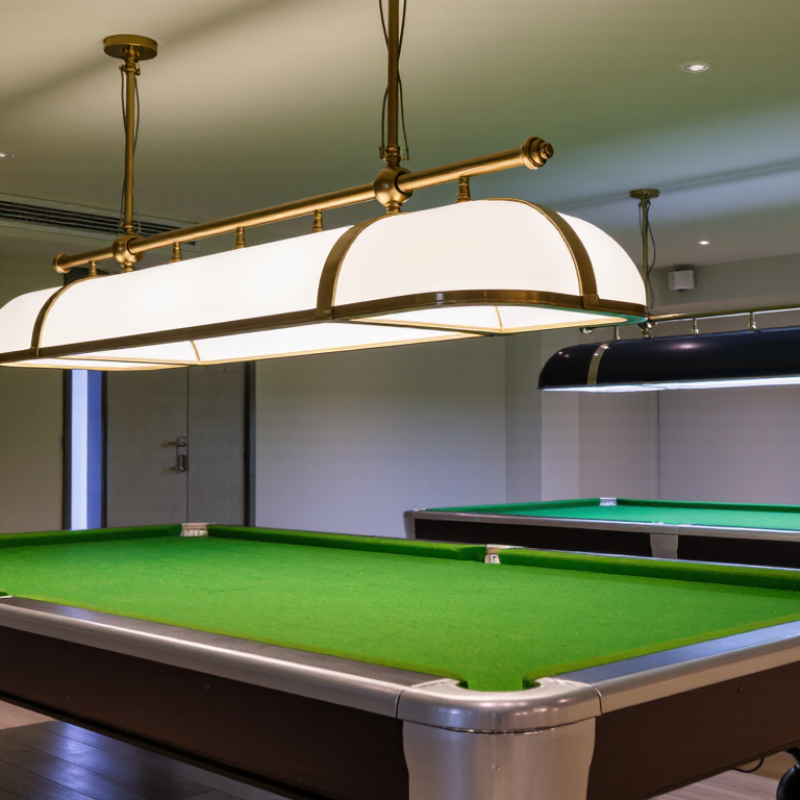
An oblong billiard pendant light is a long, horizontally arranged fixture designed to illuminate the playing surface evenly. Its elongated body usually follows the table’s rectangular geometry, reducing dark zones near the cushions. Common designs use two to four internal light sources, opaque shades, and a low-glare diffuser. The fixture should sit high enough for comfortable sightlines, yet low enough to prevent shadows from drifting across the cloth. Many professional lighting briefs target approximately 500 lux on the table, although room size and surface color can change the result.
Material choice also affects performance. Powder-coated metal shades provide durability, while frosted acrylic can soften direct brightness. A strong manufacturer will verify photometric files, color rendering, heat management, and suspension stability. The U.S. Department of Energy reports that LED lighting uses at least 75% less energy than incandescent lighting and can last up to 25 times longer. That matters in venues operating for long evening hours. Dimming controls can further reduce wasted output, but poor dimming compatibility remains a practical weakness. It deserves testing before installation. The IES Lighting Handbook also emphasizes uniform illumination and glare control for visual tasks, principles directly relevant to billiards. Buyers should compare measured lux, beam spread, and color consistency, rather than trusting decorative images alone. A beautiful pendant can still create distracting reflections on polished balls or nearby screens.
When evaluating billiard light manufacturers, inspect performance before appearance. A good supplier should provide measured lumen output, beam angle, color rendering, and glare data. The U.S. Department of Energy’s SSL research reports identify efficacy, color quality, and service life as key LED development priorities. For a billiard table, even illumination matters more than impressive brightness. Ask for lux readings at the table surface, not only laboratory lumens. Uneven light can create shadows across the cue line.
Energy use also deserves attention. The International Energy Agency reports that lighting uses about 15% of global electricity. The U.S. Department of Energy states that qualified LEDs use at least 75% less energy and last up to 25 times longer than incandescent lamps. Manufacturers should explain driver efficiency, heat management, flicker performance, and expected lifetime. Request test documents from recognized laboratories. Check whether the sample matches the production model. My own mistake was trusting a polished catalog too quickly.
Tips: Test one installed sample above a real table. Measure brightness at the corners and center. Confirm CRI 90 or higher for clearer cloth and ball colors. Ask about warranty terms, replacement drivers, coating durability, and spare parts. Also review factory quality records, inspection procedures, minimum order quantities, and packaging tests. A low price may hide unstable drivers or thin metal. That risk deserves a written answer.
Leading oblong billiard pendant light manufacturers are judged by more than polished metalwork. Experienced buyers examine beam control, glare, color accuracy, and installation stability. An oblong shade must spread light evenly across the table. Dark corners quickly expose weak optical design.
The International Energy Agency’s 2023 Energy Efficiency Market Report states that lighting uses about 15% of global electricity. That figure makes efficient light engines commercially important, not merely fashionable. Leading suppliers now combine high-efficacy LEDs with replaceable drivers and measured thermal protection. Still, efficiency claims need test records.
The U.S. Department of Energy published its 2023 Solid-State Lighting R&D Opportunities report. It identifies 200 lumens per watt as a benchmark for advanced products. Manufacturers should publish photometric files, CRI results, CCT tolerance, and flicker data. Independent laboratory testing matters. Leading oblong billiard pendant light manufacturers also manage cut lengths, ceiling heights, and service access. Those details decide whether a six-light arrangement feels balanced above a tournament table. I have seen attractive prototypes fail during glare checks. That uncomfortable lesson remains useful. Some suppliers still rely on catalog images instead of real-room measurements. Buyers should request sample installations, warranty terms, and driver replacement plans before approving volume orders.
When evaluating oblong billiard pendant light manufacturers, product quality begins with structural accuracy. The housing should remain straight along its full length. End caps must align without visible gaps. Reliable manufacturers use measured jigs during assembly. This reduces uneven light over the table. Each fixture should also receive electrical testing before shipment. Ask for reports covering insulation, grounding, heat, and dimming performance. Small details matter. A loose diffuser can create distracting shadows during play.
Material selection affects both appearance and service life. Powder-coated aluminum offers a stable, lightweight frame with good corrosion resistance. Acrylic or polycarbonate diffusers should spread light evenly without harsh glare. High-quality LED boards maintain consistent color across the fixture. However, a bright sample does not always prove long-term performance. Buyers should review lumen maintenance data, driver specifications, and thermal test records. Some manufacturers provide impressive finishes but use weak internal components. That weakness may appear months later.
Customization is valuable when room proportions or table sizes differ. Manufacturers may adjust pendant length, suspension height, color temperature, beam distribution, and ceiling hardware. Warm light can suit traditional rooms, while neutral light often improves cloth visibility. Dimming compatibility deserves careful checking. Not every control system works smoothly with every driver. Request a physical sample when surface color is important. Finish variation can occur between batches. A dependable supplier documents tolerances, packaging methods, replacement parts, and installation guidance. These records make quality easier to verify, not merely promise.
Top Oblong Billiard Pendant Lights Manufacturers
How to Select the Right Manufacturer for Your Project
Selecting a manufacturer requires more than comparing catalog prices. Oblong billiard pendant lights must provide balanced illumination across the table. Ask for photometric data, material specifications, and verified installation instructions. A reliable manufacturer should explain beam spread, color temperature, dimming compatibility, and heat management clearly. Request a physical sample when possible. Product photos can hide uneven finishes or weak diffuser details.
Review production experience with custom dimensions, suspension lengths, and ceiling conditions. Check whether the factory performs electrical safety testing and maintains traceable quality records. Confirm the warranty, replacement process, packaging method, and estimated lead time in writing. A professional supplier will discuss tolerances instead of promising perfection. That honesty matters. I have found that rushed samples often reveal small alignment issues later.
Tips: Compare at least three manufacturers. Ask for a sample under real room lighting. Measure your table and ceiling twice. Confirm voltage, dimming systems, and mounting hardware before ordering. Also, request references from similar hospitality or residential projects. Communication speed is useful, but detailed answers are more important. If a supplier avoids technical questions, pause before paying a deposit. Even experienced buyers can overlook ceiling support or glare control. A final site check may prevent an expensive correction.
Use this manufacturer-selection matrix to compare suppliers without relying on brand claims. The benchmarks combine commonly specified billiard-light requirements with applicable electrical and lighting standards.
| Evaluation Dimension | Recommended Benchmark or Project Data | Evidence to Request from the Manufacturer | Why It Matters for an Oblong Billiard Pendant | Selection Guidance |
|---|---|---|---|---|
| Electrical Safety Compliance | UL 1598 or CSA C22.2 No. 250.0 for applicable North American projects; IEC/EN 60598-1 for international projects. | Current certification number, test report, product scope, rated voltage, and report validity. | Confirms that the complete luminaire has been evaluated for construction, wiring, insulation, grounding, and thermal safety. | Prioritize suppliers with certification covering the finished luminaire, not only individual components. |
| Regional Market Access | For the European Economic Area, verify applicable CE requirements, including the Low Voltage Directive 2014/35/EU and EMC Directive 2014/30/EU where applicable. | EU Declaration of Conformity, technical file summary, EMC and electrical-safety test reports. | Reduces customs, installation, and compliance risks when the project is shipped to regulated markets. | Match the compliance package to the final installation country. |
| Hazardous-Substance Control | For EU-related projects, confirm compliance with RoHS Directive 2011/65/EU, including applicable amendments. | RoHS declaration, material declarations, and supplier-control records for electronic components and cables. | Helps control restricted substances in LED boards, drivers, solder, wiring, and metal finishes. | Require documentation for the complete assembly rather than a generic factory statement. |
| Input Voltage and Frequency | Common project configurations include 120 V / 60 Hz or 220–240 V / 50–60 Hz. Specify the exact regional requirement. | Driver label, electrical specification sheet, wiring diagram, and product sample verification. | Prevents flicker, overheating, driver failure, or unsafe operation caused by voltage mismatch. | Give the manufacturer the actual site voltage before quotation. |
| Light Output and Efficacy | A practical LED planning benchmark is approximately 100 lm/W or higher, subject to the selected diffuser, driver, and optical design. | IES or LM-79 photometric report, total luminaire lumens, input watts, and efficacy calculation. | Provides enough usable light across the playing surface while limiting energy consumption and heat. | Compare delivered lumens, not only LED-chip lumens. |
| Color Rendering | For accurate visibility of billiard-ball colors, specify CRI/Ra ≥ 90; request R9 data when color recognition is important. | LM-79 or independent photometric report showing Ra, R9, and the selected LED package. | Higher color rendering supports clearer differentiation between colored balls, cloth, and wood finishes. | Reject quotations that state only “high CRI” without numerical test data. |
| Color Temperature | Common comfortable indoor choices are 2700–3000 K; use 3500–4000 K only when a cooler commercial appearance is desired. | Correlated color temperature, chromaticity tolerance, and LED binning information. | Controls the visual atmosphere and affects how the table cloth, balls, and surrounding furniture appear. | Use one consistent CCT across all pendants in the same room. |
| Glare and Light Distribution | Prefer a continuous diffuser, concealed LED source, or controlled optic that distributes light evenly along the oblong body without bright point sources. | Photometric distribution, glare-control description, beam angle, and installation photographs or sample testing. | Reduces distracting reflections and dark zones while players look across the table. | Assess uniformity over the full table length, not just brightness directly below the center. |
| Recommended Mounting Height | A common residential planning range is approximately 30–36 inches (76–91 cm) above the playing surface; confirm local code and the room layout. | Adjustable suspension length, canopy dimensions, installation drawing, and minimum ceiling-height requirement. | Maintains useful task illumination while reducing obstruction and accidental cue contact. | Request a final reflected-ceiling or mounting-height drawing before production. |
| Dimming and Controls | Specify the required system: TRIAC/phase-cut, 0–10 V, DALI, or non-dimmable. Compatibility depends on the driver and control equipment. | Driver model, dimming curve, minimum dimming level, wiring diagram, and compatibility list. | Allows the room to shift from bright play lighting to lower ambient lighting without flicker or audible noise. | Test the actual lamp, driver, and dimmer together before approving a large order. |
| Ingress Protection | IP20 is typical for dry indoor rooms; a higher rating such as IP44 may be relevant for locations exposed to moisture, subject to design suitability. | IP test report for the complete luminaire and details of the tested configuration. | Helps match the pendant to the installation environment and cleaning conditions. | Do not treat an IP rating for a component as the rating of the finished pendant. |
| Thermal Management | Require an aluminum heat sink or equivalent thermal path and documented operating temperature at the LED board and driver. | Thermal test data, driver temperature data, heat-sink material specification, and aging-test results. | Stable thermal performance protects LED life, color consistency, and driver reliability. | Give preference to designs with replaceable drivers and accessible service points. |
| Mechanical Construction | Confirm body length, width, suspension points, ceiling-canopy size, total weight, and allowable adjustment range from the approved drawing. | Dimensioned CAD drawing, bill of materials, load data, finish sample, and installation manual. | Oblong fixtures must align with the table and remain stable without twisting or sagging. | Approve dimensions against the table size, ceiling structure, and required clearance. |
| Finish and Surface Quality | Specify the exact finish, gloss level, color reference, visible-joint standard, and acceptable tolerance before mass production. | Physical finish sample, color approval sheet, inspection photos, and documented quality limits. | Large linear pendants are highly visible; uneven coating or misaligned end caps can dominate the room’s appearance. | Use an approved golden sample as the production reference. |
| Quality-Control Process | Require incoming-material inspection, in-process checks, 100% electrical safety testing where applicable, and final visual inspection. | Quality-control plan, inspection checklist, test records, defect classification, and pre-shipment inspection option. | Reduces the risk of inconsistent color, loose wiring, damaged diffusers, and dimensional defects in a multi-unit order. | Add measurable acceptance criteria to the purchase contract. |
| Sample and Prototype Approval | Obtain at least one production-intent sample before approving the full quantity, especially for custom length, finish, diffuser, or control options. | Sample invoice, sample test report, revised drawing, and signed approval record. | Allows the project team to validate light distribution, color, proportions, and installation details in the real space. | Do not approve mass production from renderings alone. |
| Warranty and Serviceability | A written 3–5 year limited warranty is a useful commercial comparison range; verify the exact coverage and exclusions. | Warranty document, driver replacement policy, spare-parts list, response time, and service contact process. | Long linear fixtures can be costly to access, so driver and diffuser support affects lifecycle cost. | Compare warranty terms for the complete luminaire, driver, finish, and suspension hardware. |
| Commercial Planning | Request a written quotation showing unit price, tooling, sample charges, packaging, shipping terms, lead time, and minimum order quantity. | Itemized quotation, production schedule, Incoterms, packaging specification, and payment milestones. | Transparent commercial data makes anonymous supplier comparisons more accurate and reduces unexpected project costs. | Select the manufacturer with the strongest total value, documentation, and delivery reliability—not the lowest unit price alone. |
It is a long, horizontal fixture designed to illuminate a rectangular billiard table evenly. Its shape follows the table’s geometry. This helps reduce dark areas near the cushions.
Hang it high enough for clear sightlines. Keep it low enough to prevent moving shadows across the cloth. The exact height depends on the ceiling, fixture, and table size. Test the position before final installation.
Many lighting plans target about 500 lux on the playing surface. Room size and cloth color can change the result. Measure brightness at the center and four corners. Corners matter.
Powder-coated metal shades offer durability and surface protection. Frosted acrylic can soften direct brightness. Check the diffuser closely. A thin or poorly fitted diffuser may create uneven light.
Request measured lumens, beam angle, lux readings, color rendering, and glare data. Also ask about driver efficiency, heat control, flicker, and service life. Decorative photos are not enough.
High color rendering helps cloth and ball colors appear more accurately. A CRI of 90 or higher is a useful target. However, color quality alone cannot fix poor light distribution.
Yes, test the actual fixture with your planned dimming system. Some combinations flicker, buzz, or fail to dim smoothly. Test it physically. Compatibility claims can be incomplete.
Compare at least three suppliers using the same requirements. Request a physical sample under real room lighting. Measure your table and ceiling twice. Review warranty terms, spare parts, packaging, and lead time.
Avoid suppliers who provide only polished images and vague technical answers. Ask whether the sample matches production units. Check ceiling support, mounting hardware, alignment, and coating thickness. I once trusted a catalog too quickly. That was careless.
Oblong Billiard Pendant Lights combine elongated proportions, balanced illumination, and refined visual appeal, making them well suited for billiard rooms, recreational spaces, hospitality venues, and contemporary interiors. Their extended design helps distribute light more evenly across a playing surface, while features such as adjustable suspension, durable shades, efficient light sources, and coordinated finishes support both performance and decoration. When evaluating manufacturers, buyers should consider production experience, material quality, lighting consistency, safety testing, delivery reliability, and after-sales service.
Leading manufacturers distinguish themselves through carefully selected metals, glass, coatings, and electrical components, as well as flexible customization options. These may include fixture dimensions, color finishes, light temperature, suspension length, shade design, branding requirements, and project-specific packaging. To select the right supplier, compare product samples, technical specifications, customization capabilities, minimum order quantities, quality-control procedures, communication efficiency, and total project costs. A manufacturer that combines dependable craftsmanship with responsive support can help ensure that the final lighting solution matches the room’s layout, atmosphere, and long-term functional needs.