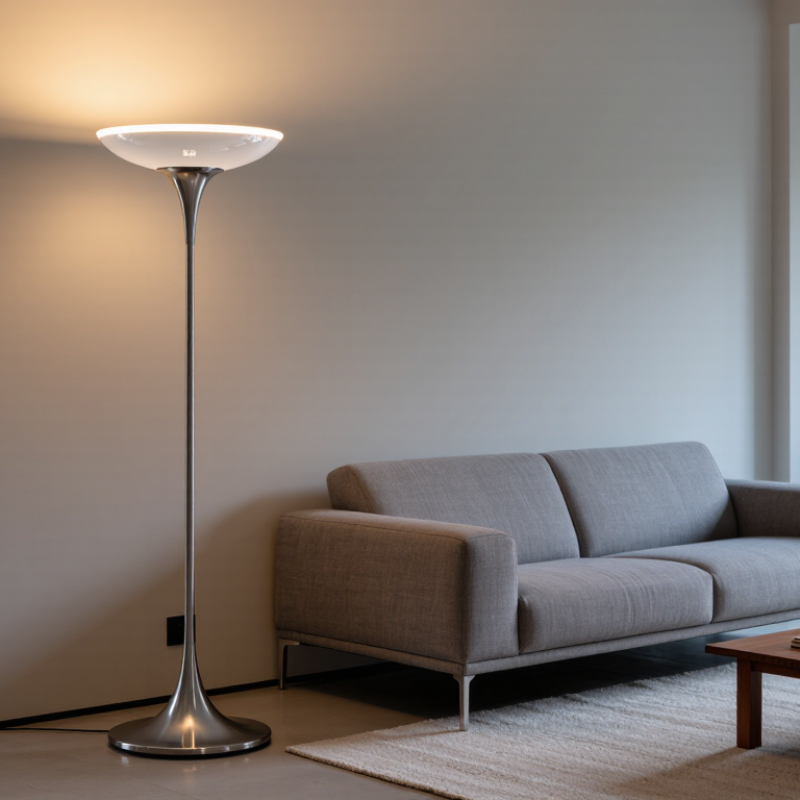
A torchiere floor lamp sends light upward, using the ceiling and upper walls to spread a soft glow across a room. Its name comes from the French word for “torch,” and its design is easy to recognize: a tall stem, a stable base, and a bowl-shaped shade that faces the ceiling. A warm pool of light appears overhead. Shadows soften around the furniture.
Torchiere Standing Floor Lamps can brighten a living room without taking up much table space. Many models use LED bulbs, while some include a small reading light or a dimmer. The lamp’s upward-facing shade matters: an open, reflective interior helps direct light toward the ceiling, where it bounces back into the room. Dark ceilings may absorb more light, so placement and bulb output affect the result. Small details count.
A torchiere is not quite a task lamp. It provides ambient light, though a model with an adjustable side light can help with reading. Lighting designer Randall Whitehead is a recognized voice in residential lighting, but I could not verify a torchiere-specific quotation from him. To avoid putting words in his mouth, treat this practical observation as editorial guidance, not a sourced quote: “Aim the light where the room can use it, not where it creates glare.” That distinction is worth checking. Before choosing a lamp, consider ceiling height, shade material, bulb compatibility, and how bright the room feels after dark. A torchiere can be elegant and useful, but it will not solve every lighting problem on its own.
What Defines a Torchiere Floor Lamp?
A torchiere floor lamp is a tall, freestanding lamp with a shade that directs light upward. The shade often resembles a shallow bowl, though some versions have a more tapered or sculpted shape. That is the signature. Light travels toward the ceiling, then reflects back into the room, creating softer, more spread-out illumination than a bare bulb aimed downward.
The upward-facing shade defines the style, but the base, pole, and controls can vary. Some lamps use a dimmer, which helps adjust the glow for reading or evening use. Others offer only a simple switch. Many are designed for indirect ambient light, so they may not brighten a desk or book as clearly as a task lamp. That distinction matters in a dim corner. Check that the base feels steady and the shade is clear of curtains or low shelves. The term can be used loosely, too; a bowl-shaped shade alone does not tell you how bright or useful a lamp will be. A little disappointing, perhaps, if you expect one lamp to do every job.
What Parts Make Up a Torchiere Lamp?
A torchiere floor lamp sends light upward, reflecting it off the ceiling to brighten a room indirectly.
Its main parts are a weighted base, a tall pole, an upward-facing bowl-shaped shade, and a light source. The base helps keep the lamp steady; the pole carries internal wiring to the socket or integrated LED module. The shade directs light upward and may use glass, plastic, or metal.
Small detail, big effect: a dusty or opaque shade can noticeably reduce the light reaching the room.
The switch may sit on the pole, cord, or shade, and some models include a dimmer. A diffuser, when fitted, softens the light and hides the bright point of the bulb. The lamp works when the switch completes the electrical circuit, powering the light source; the shade then guides its output toward the ceiling.
Check that the bulb matches the socket’s rating, and keep the base on a level surface. A tall lamp can feel secure but still tip if its base is too light.
Bulb choice affects energy use and heat. The U.S. Department of Energy’s Energy Saver guidance reports that LEDs use at least 75 percent less energy and last up to 25 times longer than incandescent lighting. That comparison is useful, though real results depend on the bulb and use. Some designs hide the bulb neatly; others leave it exposed. Not every shade spreads light evenly.
How Does Its Upward Lighting Work?
A torchiere sends light upward from a bowl-shaped shade near the top of its pole. The bulb points toward the ceiling, and the shade helps spread its beam across a wider area. The ceiling then reflects some of that light back into the room. This bounce creates soft, indirect illumination rather than a bright pool on the floor. A pale, matte ceiling usually reflects light more evenly than a dark or heavily textured one.
The effect depends on the room. In a living room with a high ceiling, the reflected glow may feel gentle but not bright enough for reading. With a lower, light-colored ceiling, the same lamp can make the space feel more evenly lit. Small detail: aim matters. A bulb that sits too low in the shade may create glare when viewed from across the room. The lamp also cannot brighten corners well if furniture blocks the reflected light. Some evenings, the ceiling looks bright while the book in your hands remains dim. That is a limitation, not a fault. A separate reading light can fill the gap, though it may make the room’s lighting feel less uniform.
What Is a Torchiere Floor Lamp and How Does It Work? - How Does Its Upward Lighting Work?
| Feature |
How It Works |
Typical Details |
| Basic design |
A tall floor-standing lamp holds a light source beneath an upward-facing shade or bowl. |
Usually consists of a base, upright stem, socket or LED module, and shade. |
| Upward light direction |
The shade directs most of the light toward the ceiling rather than straight into the room. |
The ceiling becomes the main surface that spreads the light back into the space. |
| Indirect illumination |
Light reflects off the ceiling and nearby upper walls, creating a softer, more broadly distributed glow. |
The effect depends on ceiling height, surface color, and reflectivity; light-colored surfaces generally reflect more light than dark ones. |
| Glare and shadows |
Because the light is bounced off a large surface, it is often less direct than a bare bulb aimed at the eyes. |
It can provide comfortable ambient light, but it is not always ideal for focused reading or detailed work on its own. |
| Light source |
The lamp may use a replaceable bulb or an integrated LED light source. |
Bulb type, wattage, color temperature, and dimming compatibility vary by model. Follow the lamp’s stated limits. |
| Controls and dimming |
A switch, foot control, touch control, or compatible dimmer turns the light on and may adjust its brightness. |
Dimming works only when the lamp and its bulb or LED system are designed to support it. |
| Room suitability |
The reflected light contributes general room illumination without requiring a ceiling-mounted fixture. |
Performance is best where the ceiling is unobstructed and reasonably reflective; dark or very high ceilings may reduce the perceived brightness. |
| Placement and safety |
The base supports the upright lamp, while the shade keeps the light source facing upward. |
Place it on a level surface, keep it clear of curtains and other materials, and use only the specified bulb type and maximum wattage. |
What Light Sources and Controls Can It Use?
A torchiere can use an integrated LED module or a replaceable bulb, such as an LED, halogen, or compact fluorescent lamp. Its upward-facing shade sends light toward the ceiling, which softens the room’s overall glow. Small details matter. A foot switch is convenient beside a sofa, while a rotary control can offer gradual dimming. Some models use touch controls or smart plugs, but those features do not automatically make every bulb dimmable.
The U.S. Department of Energy reports that LEDs use at least 75% less energy and last up to 25 times longer than incandescent bulbs. These figures describe LEDs generally; actual performance depends on the product and use. Not every LED dims. Check the bulb’s label and the lamp’s instructions before pairing it with a dimmer. Integrated LED models may require replacing the whole light assembly if the light source fails, so check service information before buying.
Tips: Aim the shade toward a pale ceiling for a broad, gentle wash of light. For reading, add a separate task light; a torchiere’s bounced light may leave pages dim. If a dimmer causes flickering or buzzing, stop using that combination and verify compatibility. One small catch: room color and ceiling height can change how bright the lamp feels.
What Light Sources and Controls Can a Torchiere Floor Lamp Use?
Typical available color-temperature ranges vary by bulb type. Check the lamp’s socket and label before choosing a bulb.
How it works: A torchiere directs light upward to reflect off the ceiling. It may use incandescent, halogen, CFL, or LED bulbs if they fit the socket and meet the lamp’s wattage rating. Controls can include an on/off switch, a rotary or touch control, or a dimmer. Dimming works only when the lamp and bulb are compatible; many CFLs and LEDs require bulbs specifically labeled dimmable.
How Should a Torchiere Lamp Be Positioned and Used Safely?
A torchiere sends light upward, so place it on a level floor where the ceiling can reflect light across the room. Keep the bowl clear of shelves, ceiling fans, and anything that could touch the bulb. Give curtains and bedding generous space. Set the lamp beside a wall, not in a doorway or narrow walkway. Check that its base feels steady; a plush rug can make a tall lamp wobble. Small detail, big difference.
Route the cord along a wall, never beneath a rug or across a walking path. Use only bulbs within the fixture’s marked wattage limit, and switch off the lamp before changing one. The U.S. Department of Energy’s Energy Saver guidance says LEDs use at least 75% less energy and can last up to 25 times longer than incandescent bulbs. That can reduce heat and replacement frequency, but it does not override the fixture label. Avoid touching a recently used bulb. For a softer, less glary room, try a dimmable LED and aim light toward a pale ceiling. It may take a few adjustments; the first spot that looks right can still leave a bright patch in your eyes.
Conclusion
A torchiere floor lamp is a tall, freestanding light designed to direct illumination upward rather than straight into a room. Its main parts typically include a weighted base, a vertical pole, a light socket, and a bowl-shaped or flared shade that spreads light toward the ceiling. By reflecting off the ceiling and upper walls, the lamp creates soft, indirect ambient lighting that can make a space feel brighter without producing a harsh beam.
Torchiere Standing Floor Lamps can use LED, incandescent, or other compatible bulbs, depending on the fixture’s specifications. Some models include a dimmer, a touch control, or a foot switch, allowing the brightness to suit different activities. For stable, comfortable use, place the lamp on a level surface where it will not obstruct walkways, and position it to avoid glare on screens. Keep it away from curtains and other materials that could block the shade or come into contact with a hot bulb, and follow the lamp’s instructions for bulb type and wattage.